
Types of IPTV: Complete Guide to IPTV Services in 2026
Par tech blog · 11 octobre 2026 · 9 min
Introduction
Understanding the types of IPTV can help you choose a streaming service that matches your entertainment needs, budget, and preferred viewing habits. IPTV, or Internet Protocol Television, delivers television content through internet networks instead of relying exclusively on traditional cable or satellite broadcasting.
Different IPTV services offer different viewing experiences. Some focus on live news and sports, while others provide recorded programs, movies, television series, or interactive features. Certain platforms combine several delivery methods in one subscription.
Whether you watch television on a Smart TV, Android TV box, smartphone, tablet, or computer, understanding these options makes it easier to compare services and select the right solution.
This guide explains the main types of IPTV, how they work, their advantages and disadvantages, and what to consider before choosing a provider.
What Is IPTV?
IPTV stands for Internet Protocol Television. It is a method of distributing television and video content through internet protocol networks.
Unlike traditional broadcast television, IPTV can deliver content through managed networks or internet-based streaming platforms. The viewing experience depends on the service’s technology, network performance, applications, and available content.
Common IPTV features include:
- Live television channels
- Movies and series on demand
- Program schedules through an electronic program guide (EPG)
- Replay and catch-up features
- Pause and playback controls where supported
- Access through compatible devices
It is important to distinguish the technology from the provider. IPTV itself is a delivery method; individual services must have appropriate rights to distribute the content they offer.
What Are the Main Types of IPTV?
The main types of IPTV are live IPTV, time-shifted television, catch-up TV, and video on demand. Some providers also offer near-video-on-demand services and interactive television features.
1. Live IPTV
Live IPTV allows viewers to watch television broadcasts as they are transmitted, similar to traditional cable or satellite TV.
Programs may include news, sports, entertainment, documentaries, and regional television channels.
How it works: The provider distributes a live stream over an IP network, and viewers access it through a compatible application, set-top box, or television platform.
Advantages:
- Suitable for live sports and breaking news.
- Offers a familiar channel-based viewing experience.
- Can provide access to international programming where authorized.
- May include electronic program guides.
Disadvantages:
- Requires a stable internet connection.
- Some channels may experience interruptions.
- Availability depends on regional rights and the provider’s agreements.
Live IPTV is particularly useful for viewers who prefer scheduled programming instead of selecting individual videos.
2. Video on Demand (VOD)
Video on demand allows viewers to choose a movie, episode, or other video and watch it whenever they want.
Instead of following a fixed television schedule, users browse a catalog and select the content that interests them.
Examples include subscription streaming libraries, rental platforms, and licensed on-demand services.
Advantages:
- Flexible viewing schedules.
- Convenient access to movies and television series.
- Playback controls such as pause and resume.
- Content discovery through search and recommendations.
Disadvantages:
- Catalogs vary by subscription and country.
- Popular titles may require additional payments.
- Internet quality can affect playback.
VOD is a good choice for people who prefer personalized entertainment and want more control over what they watch.
3. Catch-Up TV
Catch-up TV allows viewers to watch selected programs after their original broadcast.
For example, a broadcaster might let users replay a news program or television episode for a limited period after it airs.
Catch-up availability depends on the broadcaster’s rights, platform features, and retention period.
Advantages:
- Helps viewers who miss scheduled programs.
- Reduces the need to record shows manually.
- Makes some live programming more flexible.
Disadvantages:
- Not every program is available for replay.
- Content may expire after a specified period.
- Some services restrict replay to particular channels or subscription tiers.
Catch-up TV is especially helpful for people with busy schedules who still want to follow regular television programs.
4. Time-Shifted IPTV

Time-shifted IPTV allows viewers to watch television at a different time from the original broadcast. Depending on the service, this may involve pausing a live program, rewinding it, or accessing an earlier portion of a broadcast.
Although the term overlaps with catch-up TV, time-shifted television can also describe playback controls used while a program is being broadcast.
Advantages:
- Greater control over viewing time.
- Useful for pausing live events.
- Can help viewers review a missed scene or important moment.
Disadvantages:
- Depends on platform functionality.
- Rewind and replay limits may apply.
- Not all channels support time-shifting.
The main benefit is convenience: viewers gain more control over when and how they watch television.
5. Near Video on Demand (NVOD)
Near-video-on-demand is a delivery model in which the same program starts at scheduled intervals across multiple streams or channels.
For example, a movie might begin every 15 or 30 minutes, allowing viewers to join a showing without waiting for a single fixed start time.
This model has historically been used in certain television distribution systems and differs from modern VOD, where viewers can generally start content on demand.
Advantages:
- Offers more flexible start times than a single scheduled broadcast.
- Can provide a structured viewing experience.
- Does not require a fully individualized stream for every viewer.
Disadvantages:
- Viewers may still need to wait for the next showing.
- Selection is often more limited than a full VOD library.
- It is less flexible than true on-demand playback.
NVOD is useful to understand as a distinct delivery model, although it is less prominent in many modern consumer streaming services.
Comparison of IPTV Types
| IPTV Type | Main Purpose | Viewing Time | Best For |
|---|---|---|---|
| Live IPTV | Real-time broadcasts | Scheduled | Sports, news, live events |
| Video on demand | Selected videos | Anytime | Movies and series |
| Catch-up TV | Replay past programs | After broadcast | Missed episodes and shows |
| Time-shifted IPTV | Pause, rewind, or replay | Flexible, depending on features | Busy viewers |
| Near video on demand | Repeated scheduled showings | Set intervals | Scheduled movie viewing |
Some services combine several of these options. A single legitimate platform may offer live channels, replay features, and a VOD catalog.
Which Devices Support IPTV?
IPTV can work across various devices, but compatibility depends on the platform and service.
Smart TVs
Many modern Smart TVs support streaming applications directly. Check the manufacturer’s application store and the provider’s supported-device list.
Android TV and Google TV
Compatible devices can run supported streaming applications. Available features depend on the application and subscription.
Streaming Devices
Certain streaming sticks and TV boxes can provide access to IPTV-compatible applications. Download software from trusted sources and confirm that it supports your device.
Smartphones and Tablets
Mobile devices are useful for watching content while travelling or away from the main television. Mobile data consumption may be significant during extended streaming sessions.
Computers
Some authorized IPTV platforms provide browser-based playback or desktop applications.
Before subscribing, verify that the service works on your preferred device and that your operating system meets its requirements.
What Internet Speed Do You Need for IPTV?
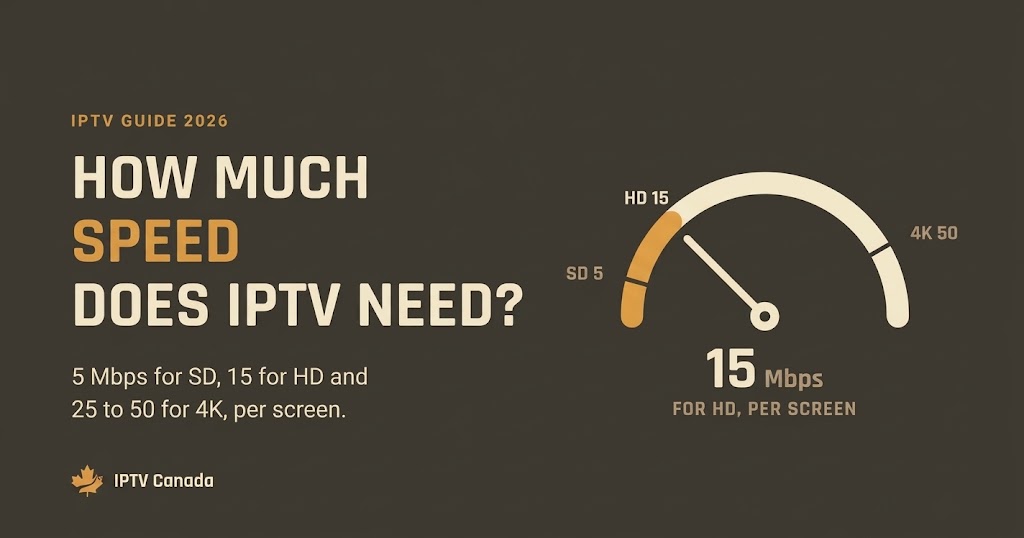
The required internet speed depends on video resolution, compression, network congestion, and the number of simultaneous streams.
As a general starting point, approximately 5–10 Mbps may be sufficient for many HD streams, while 4K streaming often benefits from 15–25 Mbps or more per stream. Actual requirements vary by platform.
For a smoother experience:
- Use Ethernet when practical.
- Keep your Wi-Fi router in a suitable location.
- Reduce unnecessary network congestion.
- Update your streaming application and device.
- Test playback during the hours you normally watch television.
A fast connection cannot completely prevent buffering if the streaming provider has technical problems.
How to Choose the Right Type of IPTV
The best option depends on your viewing habits.
Choose live IPTV if you regularly watch news, sports, or scheduled television programs.
Choose VOD if you prefer selecting movies and series at your convenience.
Choose catch-up TV if you often miss scheduled broadcasts and want to replay eligible programs.
Choose time-shifted television if pausing or rewinding live programming is important to you.
If you want several viewing options, consider a licensed service that combines live television and on-demand content.
Before paying, compare subscription costs, supported devices, content availability, cancellation terms, customer support, and the provider’s authorization to distribute its programming. Avoid choosing a service based solely on advertised channel counts.
Common IPTV Mistakes to Avoid
- Ignoring licensing: Confirm that the provider has the necessary rights to distribute its content.
- Overlooking device compatibility: Check support for your specific television or streaming device.
- Underestimating internet requirements: Account for other devices using the same connection.
- Focusing only on price: Consider reliability, relevant content, and customer support.
- Ignoring subscription terms: Review automatic renewals, cancellation rules, and refund conditions.
These checks can help you avoid unnecessary costs and choose a service that meets your expectations.
Key Takeaways
- IPTV delivers television and video content through internet protocol networks.
- Live IPTV is designed for real-time broadcasts.
- VOD lets viewers select movies and programs whenever they want.
- Catch-up TV provides access to eligible programs after they air.
- Time-shifted IPTV offers playback flexibility, including pausing or rewinding where supported.
- Near-video-on-demand uses repeated scheduled showings rather than fully individualized playback.
- Device compatibility, internet stability, licensing, and subscription terms all matter when choosing a service.
Frequently Asked Questions
1. What are the four main types of IPTV?
Four commonly discussed types are live IPTV, video on demand, catch-up TV, and time-shifted television. Near-video-on-demand is another delivery model. The categories can overlap because some platforms combine several features.
2. What is the difference between IPTV and VOD?
IPTV is a broad technology for delivering television over IP networks, while VOD is a content-delivery model that lets viewers choose videos to watch on demand. VOD can be one feature within a larger IPTV service.
3. Is live IPTV better than VOD?
Neither is universally better. Live IPTV suits scheduled programs and live events, while VOD is more flexible for movies and series. Your viewing habits determine which option is most useful.
4. Can IPTV work without a Smart TV?
Yes. Compatible streaming devices, TV boxes, smartphones, tablets, and computers can support IPTV services. You should check the provider’s supported devices and application requirements before subscribing.
5. Does IPTV require an internet connection?
Internet-based IPTV generally requires a network connection to receive streams. Some services may support limited downloads or offline playback, but this depends on the platform.
6. Is IPTV legal?
IPTV technology is legal in itself. The important consideration is whether the provider has the appropriate rights to distribute its channels, films, and series.
7. Can one IPTV service provide live TV and movies?
Yes. Some authorized services combine live television, video on demand, and catch-up features. The available content and functionality depend on the provider and subscription package.
Conclusion
Understanding the different types of IPTV helps you select a viewing experience that fits your schedule and entertainment preferences. Live IPTV is suitable for real-time broadcasts, VOD provides flexible access to movies and series, catch-up TV helps you revisit missed programs, and time-shifted television offers additional playback control.